
 Everything starts here.
Module · Strategy & steering
Write your strategy down once, and stay on course all year.
Stay on course brings your strategy, your goals and how you steer the business together in one place. It's the foundation of Marcel: everything I write elsewhere starts from here. We set out your strategy in 14 sections, draw your goals from it, and follow the year quarter by quarter.
Demo by video call or in person · Free audit
The problem
Your strategy is clear. In your head.
It isn't written down anywhere, so the team has to guess. And what isn't written down can't be steered.
Every decision gets re-argued
With no written direction, everyone decides case by case: a client to take on, an offer to launch, a hire to make.
Goals get forgotten
Set in January, lost by March. Nobody knows where you started, or where you are now.
Steering comes last
The leadership meeting gets prepared the night before, the budget at the last minute. The urgent always wins.
Its strategy · the CED
14 sections, in four families.
The strategy behind Stay on course is the CED, the Dynamic Business Canvas created by Olivier Giry: your overall strategy, and how it plays out in sales, marketing and communication, people, finance and legal. For each section, I run the interview like a specialist in the field, then suggest a text. You add it, or you don't.
Where you're heading
Vision, Governance.
What you do, and for whom
Targets, Offers, Acquisition, Customer experience, Tech, Tools & AI, Identity & Communication, Partners, Admin & Legal.
With whom, and what for
Human & Culture, Impact.
How it holds up
Revenue, Costs.
Each dimension carries its status — empty, vague, needs detail, clear. Here, a strategy that has been worked all the way through.
Each section carries its status — Empty, Vague, Needs detail or Clear — and the module gets a strategic clarity score from 0 to 100.
Six tabs
Everything you need to steer, in one place.
Stay on course has the same shape as the other four modules: six tabs, one logic.
Strategy
The 14 sections of the CED
Read end to end, like a single document, with a table of contents and each section's status. Anything vague shows up straight away.
Goals
Five at most
Each with its target, its success criteria and its measure: where you started, where you're going, where you are. I challenge each one and tie it back to the strategy.
Library16 documents
One strategy per section
Vision strategy, Acquisition strategy, Human & Culture strategy… then the SWOT and the leadership committee. Each one is Produced, In progress or To produce.
Annual plan
The year, quarter by quarter
Four columns, Q1 to Q4, plus a Permanent column. One card per task, which you drag from one quarter to the next.
Tasks
What needs to move
The away day, the leadership meeting, the budget: every task has an owner and a due date. The ones I suggest arrive for you to approve.
Team
Who holds the course
Leadership, your partners, your consultant if you have one. Everyone is linked to the modules they work in.
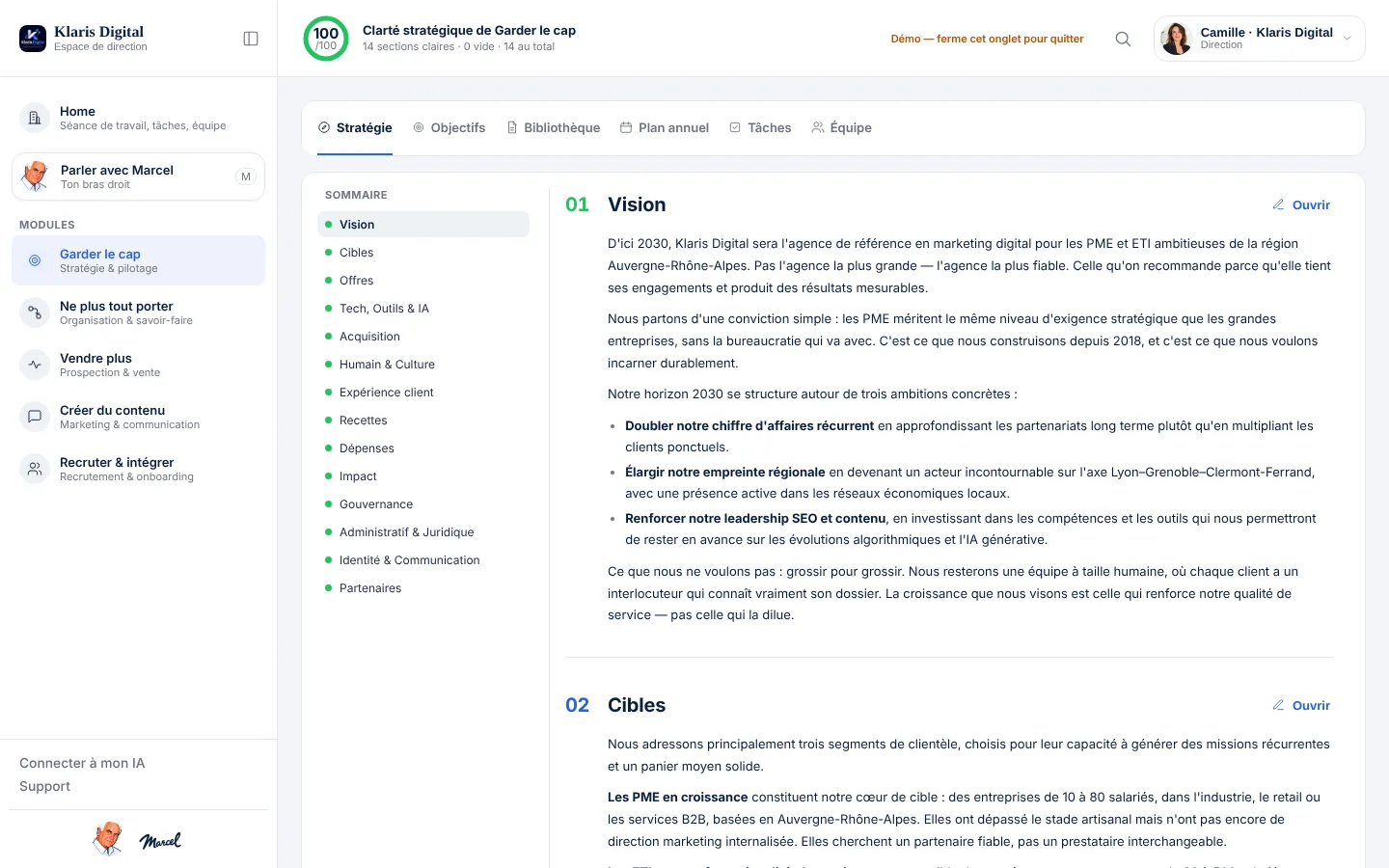
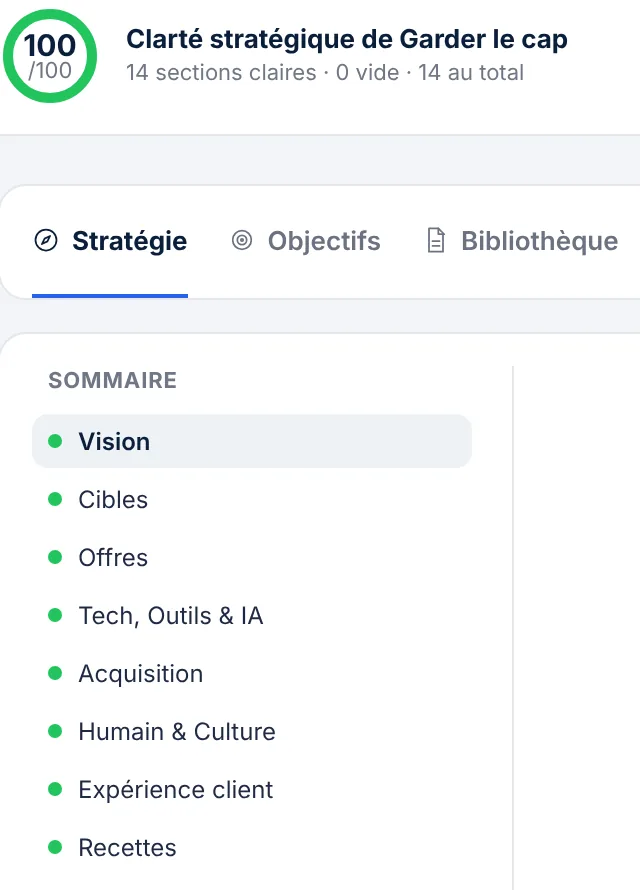 I tell you what's clear, and what still needs work.
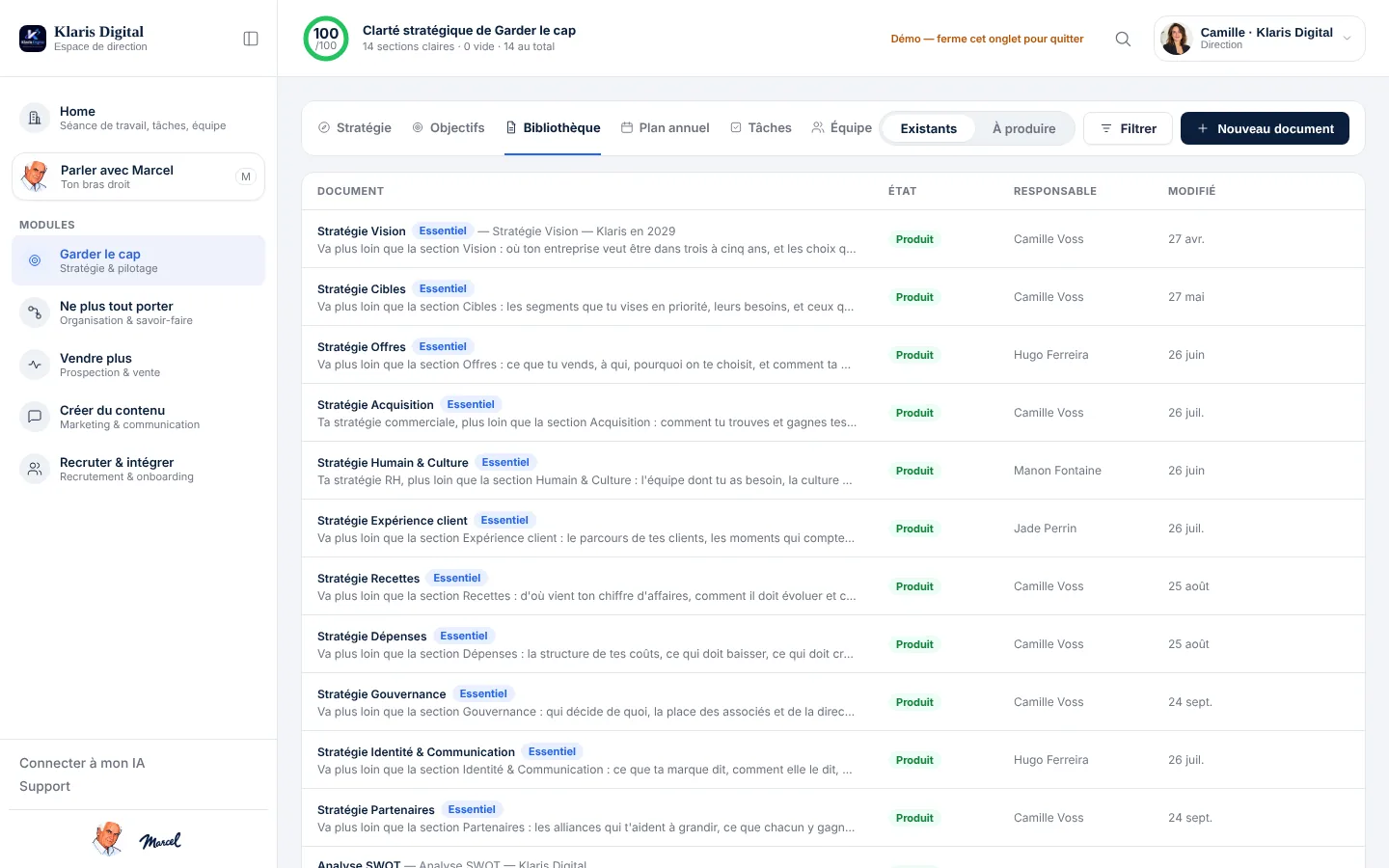
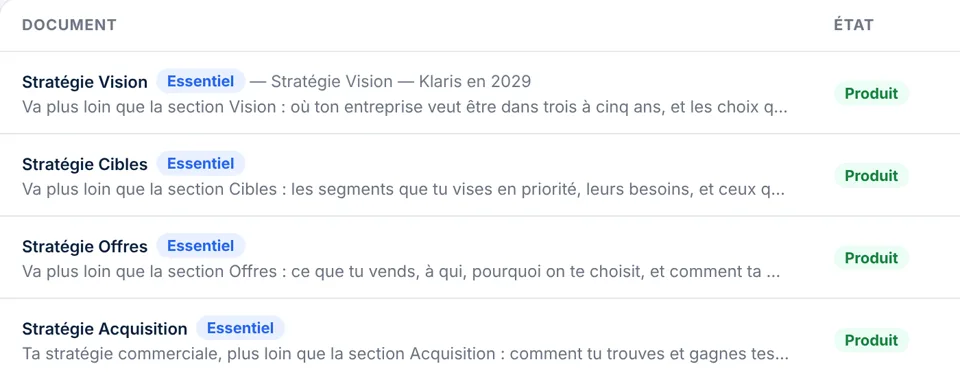 The module's documents, and who owns each one.
Your team reads the strategy and the goals in their team member space. And so does your AI, in Claude or ChatGPT.
In the demo
Klaris Digital, a Lyon agency getting itself structured.
In the demo, Camille, the founder, has set her direction with Hugo, her head of SEO, and Julien, their consultant.
“Review how much of the revenue the top three clients bring in: three clients make up half of it. That's the agency's biggest risk.”
My suggestion to Camille, as a task to approve
The other modules
The foundation, then one module per area.
Stay on course comes with every plan. The other four modules are added as you need them, and each goes further in its own area, with its own strategy.
Stop carrying it all.
Write down how the business runs, so it runs without you.
Sell more.
Find clients, follow your opportunities, close more deals.
Create content.
Make your business known, in your own voice.
Hire & onboard.
Hire the right people, and help them succeed from day one.